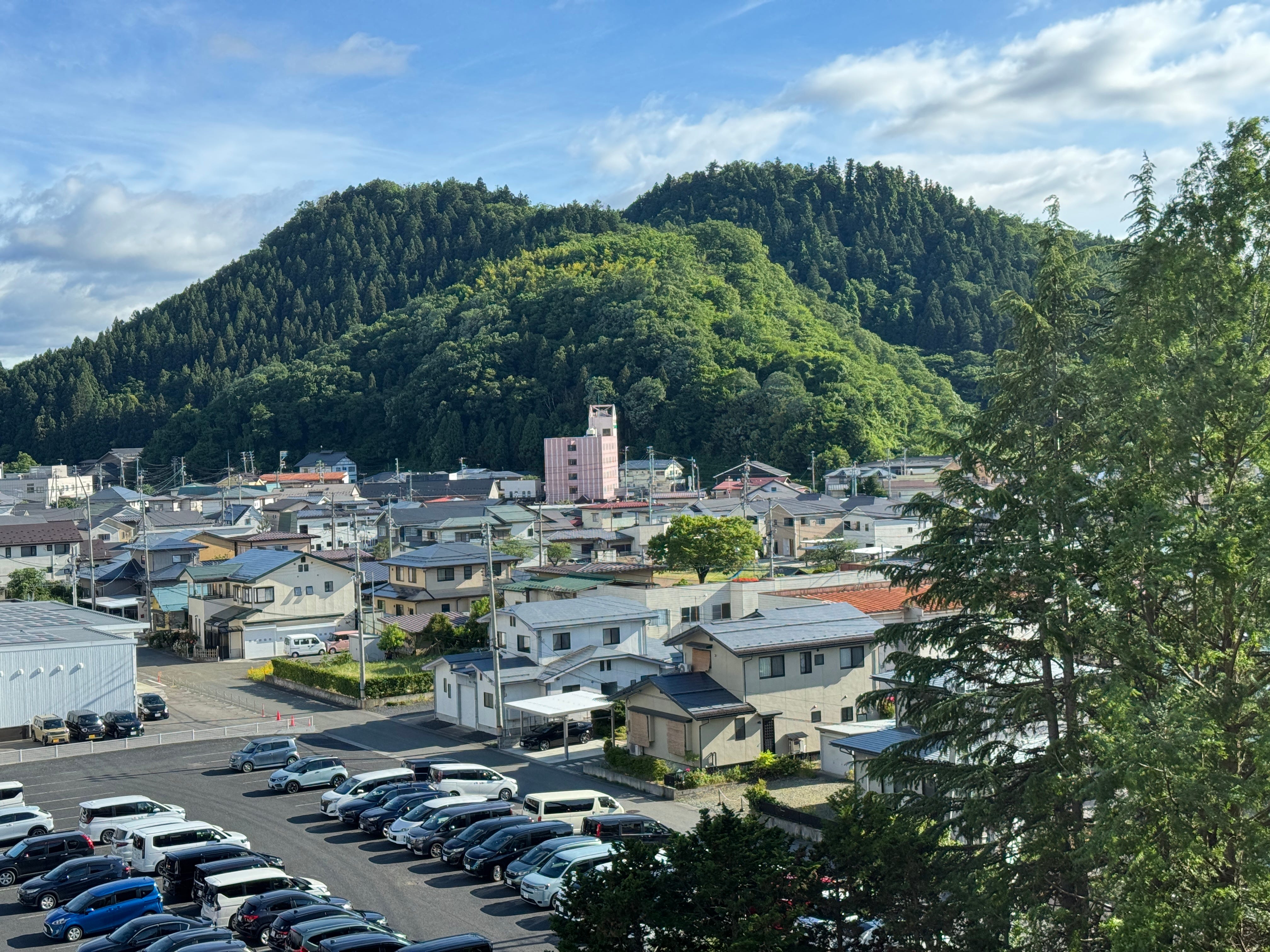
The Heavenly Children of Dancing Crane Mountain: Maizuru-yama in Tendo
And the origin of the name Tendo: 'Heavenly Children'
Last week I shared what I guess would be a bit of a teaser, although I never intended for that. Well, think of this as the first part of the teaser, Maizuru-Yama in Tendo City, the next mountain on my 100 Famous Mountains of Yamagata Project (#37?). Basically, I wanted to share a report of my climb up the mountain, but I found out the mountain was much, much, more than I had anticipated.
Not Maizuru, though.
Maizuru-yama is a mountain in the middle of Tendo City, Yamagata Prefecture.‘Mai’ means dance, and Zuru is the voiced tsuru, so technically it should be dzuru, for crane, but who has time for that. In other words, Maizuru-yama is ‘Dancing Crane Mountain’. A very descriptive and poetic name, but not very original. This isn’t the only instance of ‘Dancing Crane’ in Japan, far from it:
Notably, there is Maizuru City on the northern coast of Kyoto prefecture, named after a samurai castle and because the shape of the bay resembles two cranes in flight. ‘Maizuru’ also appears as a nickname for two different fortresses: Kōfu castle in Yamanashi, and Fukuoka castle in Kyushu, for example. In those cases, the dancing crane refers to the brilliant white walls of the castles. What makes Maizuru-yama in Tendo City so special is that it is named for the ridges of the mountains themselves, something completely natural for once.
No, today I’m interested in the origin of the word ‘Tendo’ written 天童, a real odd one.
Personally, I love the shape of these Kanji; I think they balance each other perfectly. But the truly interesting thing is the namesake.
Why?
天 ‘ten’ means heaven.
童 ‘dō’ (elongated ‘o’) means juvenile, or simply ‘child’.
Heavenly Juvenile?!
Or, I guess, ‘heavenly child or children’.
Like a child who does what they’re told? Where do I get one of those?
Tendo. Apparently.
Alas, the heavenly part of Tendo doesn’t have anything to do with children behaving well.
It is entirely about where they came from:
Heaven.
Where else?
Legend has it that around 1200 years ago (oddly specific), a Buddhist monk by the name of Gyoki (cool name) climbed all the way to the summit of Maizuru-yama to pray. Which, and I’ve been there, isn’t as tough as it sounds to reach.
As he was chanting Buddhist chants (what else? not the first time something happened simply because of chanting), some mysterious music started playing in the distance. Next minute, the sky appeared to tear apart in the centre, and two dancing celestial beings came down leaving behind a wake of purple haze, a la Jimi Hendrix.
Their names?
Goei Doji, and Makatsu Doji (notice the ‘do’?, it’s the same one). These two children then proclaimed to Gyoki:
“We are messengers of Jizaiten Buddha (AKA Kangiten). You, noble monk, are the Great Bodhisattva of this peak. You must build a sacred hall here, and pray for the salvation of all sentient beings”.
And as soon as they said that, they vanished (just like the perfect child). But not before the purple haze sank into the soil of the mountain, leaving it more sacred than it already was.
Not one to take fate lightly, Gyoki marked the exact spot at the summit where the two deities touched the earth by planting a Zelkova tree, oh, and I guess some cherry blossoms too. He then named the peak after the two deities: ‘Tendo-zan’ ‘Heavenly Children Mountain’. Not long after, one of Gyoki’s disciples, Kigen, built Tendo-Den (Tendo shrine) at the summit of the mountain to honour the heavenly children.

The community that grew around the base of the mountain over the following years took the same name. Soon the whole area, rather than the mountain alone, also took the name. Tendo mountain in Tendo city (or town, it became a city in 1958) was a bit tedious for the townspeople, so they gave the mountain the new (as we have already established, unoriginal) name Maizuru-Yama, after the way its ridges droop down resembling a dancing crane.
Technically, the mountain is still known as Tendo-zan. At the very least, it is now ‘Tendo Park’, and there is a Tendo Jinja at the base that preserves the exact spot of the legend. Except it doesn’t, because the exact spot of the legend was at the summit where the Zelkova and the original Tendo-den stood.
Because, what happened was,
Politics!
And War!
Don’t worry, I won’t bore you like George Lucas in the prequels, I hope. During the warring states period, despite the sacred nature of Maizuru-yama, it was seen as the perfect location for a mountain castle.
Because of course it is. Those beautiful ridges aren’t just the wings of a crane, they’re also a self-defence masterpiece! (more on that next time)
Before it was Tendo city, it was the Tendo clan, and the Tendo clan had to defend themselves from, well, civil war! So they turned Maizuru-yama into a castle. And having a shrine at the summit of the mountain castle like that was seen as a security risk. So they did what they always do, moved it to the base of the mountain, the location of the current Tendo Jinja.
And so, the grand naming loop was complete: the heavenly children gave their name to the mountain, the mountain gave its name to the town, the town stole the name completely, and the locals looked up at the empty ridges, saw a crane taking flight, and named it Dancing Crane Mountain.
Where the heavenly children come from.
What happens if you chant Buddhist chants?
Sources (Japanese):
https://www.uraken.net/chimei/yamagata.html
http://www.ikechang.com/history/name0.htm
https://www.city.tendo.yamagata.jp/municipal/machidukuri/hayawakari.pdf
Daily Yamabushi Posts for June 5 to 11, 2026
Here are my Daily Yamabushi posts for the past week. Get more Daily Yamabushi posts at timbunting.com/daily-yamabushi. Discover more Japan essays and daily insights in the Kiwi Yamabushi Substack Archive, or follow my writing over on Medium.com.


These photos of small towns would be cities here in Australia .
So a Buddhist monk's followers built a Shinto shrine at the spot where he was told he was a Bodhisattva ?
That's ... different.
The castle part sounds quite like a place I'm pretty sure I've mentioned before in Eastern Shimane: Gassan Todajo (月山富田城), which was an extremely defensible castle and home of the Amako clan until the Mori came along, besieged the place and eventually conquered it near the end of the Sengoku period